
PJM Auction Procures 134,479 MW of Generation Resources
SOURCE PJM Interconnection
Price, largely unchanged, comes in at FERC-approved cap; total capacity cleared is short of reliability standard; certain mitigating factors and expected Board action could reinforce reliability in this and future delivery years
VALLEY FORGE, Pa., Dec. 17, 2025 /PRNewswire/ -- PJM Interconnection today announced the results of its 2027/2028 Base Residual Auction (BRA), which secured 134,479 MW of unforced capacity generation (UCAP) and demand response (DR) to meet projected electricity needs for more than 67 million people across 13 states and the District of Columbia.
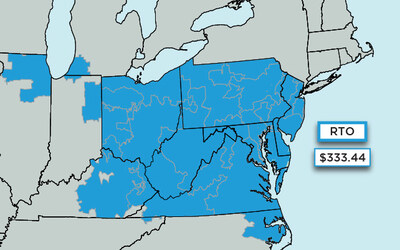
Regions under the Fixed Resource Requirement (FRR) acquired an additional 11,299 MW in UCAP, for a total of 145,777 MW (UCAP) available to serve forecasted peak electricity demand, plus a reserve margin. UCAP represents a generation resource's maximum output adjusted for its estimated ability to reliably perform at times of highest system risk.
The price came in at the FERC-approved cap, $333.44/MW-day (UCAP) for the entire PJM footprint, a slight increase (+1.3%) from the 2026/2027 Base Residual Auction. The cap, agreed to be in place for the Base Residual Auctions for delivery years 2026/2027 and 2027/2028, is calculated using the accredited capacity of the PJM reference resource. The cleared supply in the auction times the clearing price totals $16.4 billion, although not all load pays this clearing price because of the impact of self-supply and bilateral contract arrangements.
The capacity of the resources procured in the auction, plus FRR resources, is short of PJM's reliability requirement by 6,623 MW, meaning that the committed supply is less than what would be required to meet the one-event-in-10-year reliability standard of a 20% reserve margin. This does not necessarily mean, however, that the PJM system will be unable to serve load reliability in the delivery year. PJM continues to hold a reserve margin of 14.8%, and there are several mitigating factors that could improve the reliability picture for the system in the 2027/2028 Delivery Year.
Those factors include an expected reduction in the forecasted peak demand for the 2027/2028 Delivery Year; the potential for generators with announced retirements to continue operating; and capability from winter-only resources that could not be matched in the auction with summer-only resources and therefore did not receive an annual commitment, but are expected to be available to provide energy in the winter when the system is at its greatest risk. PJM will conduct an Incremental Auction for the 2027/2028 Delivery Year in February 2027.
"We believe that these factors will result in the system being very close to the one-in-10 standard in the delivery year," said Stu Bresler, Executive Vice President – Market Services and Strategy, who becomes chief operating officer on Jan. 7. "But this auction leaves no doubt that data centers' demand for electricity continues to far outstrip new supply, and the solution will require concerted action involving PJM, its stakeholders, state and federal partners, and the data center industry itself."
The forecast peak load for the 2027/2028 Delivery Year is approximately 5,250 MW higher than the forecast used for the 2026/2027 capacity auction. Nearly 5,100 MW of that increase is attributable to data center demand.
PJM stakeholders and the PJM Board recently completed an accelerated stakeholder process, the Critical Issue Fast Path, to address the integration of data centers and other large loads onto the PJM system. During that process, stakeholders put forth a number of proposals discussing mechanisms for obtaining new supply and the flexibility of new demand during peak days that would preserve reliability. The PJM Board is considering these proposals and is expected to take action in the coming weeks.
Auction Statistics
Wholesale capacity acquired through the auction accounts for a fraction of wholesale electricity costs; other contributing elements include the daily cost of power and maintenance and expansion of the transmission system. Wholesale costs make up a portion of retail electricity bills.
The cleared resource mix in this auction includes: 43% natural gas, 21% nuclear, 20% coal, 5% demand response, 4% hydro, 2% wind, 2% oil and 1% solar. These results were impacted by changes in Effective Load Carrying Capability (ELCC) ratings that assess the reliability value of each resource class. The amount of capacity that offered as DR resources, for instance, did not change significantly between auctions, but an increase in ELCC for DR resulted in an increase of cleared megawatts from 5,531 MW in the last auction to 7,299 MW in the 2027/2028 auction.
Supply offered into the 2027/2028 BRA increased 956 MW (UCAP), from 135,192 MW in the 2026/2027 BRA to 136,148 MW in the 2027/2028 BRA.
The auction cleared 774 MW UCAP of new generation and generation uprates. The total amount of cleared capacity increased by 371 MW UCAP, from 134,376 MW in the 2026/2027 BRA to 134,747 MW UCAP in the 2027/2028 BRA.
The total amount of supply in the PJM service area increased from 196,650 MW to 200,994 MW, or an increase in the total amount of supply by 4,344 MW installed capacity, or ICAP. ICAP represents the total amount a generation resource can produce; UCAP represents its accredited capacity that can be offered in the capacity auction.
The 2027/2028 Base Residual Auction is the first auction in which the entire RTO, including Fixed Resource Requirement areas, fell short of the reliability requirement. The 2026/2027 auction's cleared volume and FRR committed capacity was just over (by 139 MW UCAP) the projected reliability requirement. The target Installed Reserve Margin is set to meet the one-in-10 reliability standard; it accounts for anticipated resource performance and a margin of error for demand forecast uncertainty.
This auction also saw the continued trend of the addition of large data center loads to the load forecast that forms the basis of the reliability requirement.
Market Rule and Other Significant Changes Implemented
The auction also reflected recent market rule changes, including:
- Implementation of a cap of $256.75 $/MW-ICAP ($333.44 $/MW-UCAP) and a floor of $138.25 $MW-ICAP ($179.55 $/MW-UCAP) to the Variable Resource Requirement (VRR) Curve. A floor and cap were in effect for the 2026/2027 and 2027/2028 BRAs. All offers below the floor were cleared, and all offers above the cap were not cleared.1
- For the second consecutive auction, PJM submitted $0 offers for specific Reliability Must-Run units, ensuring reliability while managing costs (revenue to be allocated as a credit to associated load)
- Required DR availability increased to all hours in the year, and the calculation of the winter peak load was updated to a coincident value. This was a major driver in the increase of the ELCC value for DR from 69% in the 2026/2027 BRA to 92% in the 2027/2028 BRA.
- The Chanceford-Doubs 500 kV backbone transmission line was delayed, which significantly impacted MAAC, SWMAAC and DOM Capacity Emergency Transfer Limits (CETLs).
Addressing Supply-Demand Imbalance
The supply-and-demand imbalance that PJM and much of the nation are currently experiencing requires action on multiple fronts, including speeding the entry of new generation onto the system, maintaining and maximizing existing generation, and finding ways to increase the flexibility of system demand.
As part of its reforms to speed interconnection with the system, PJM has processed more than 170,000 MW of new generation requests since 2023, with 30,000 MW of generation projections left in the interconnection transition queue to be processed in 2026. PJM's new Cycle process opens in April, with a one- to two-year timeline for reviews, depending on the impact to the system.
Approximately 57 GW of projects have completed PJM's study process and have either signed or been offered generation interconnection agreements and are free to proceed to construction. Many of these projects, however, continue to be slowed or stopped by factors unrelated to PJM, including local opposition, state/local permitting delays, supply chain challenges or financing.
Recognizing that electricity demand is increasing faster than generation is being added, PJM is working on multiple fronts to further streamline our Interconnection Study processes. This includes our collaboration with Google/Tapestry, to leverage artificial intelligence to further streamline the study process and reduce study timelines.
The Federal Energy Regulatory Commission this year also approved a PJM-proposed expansion of Surplus Interconnection Service to augment the operating efficiency and availability of existing resources, and the Reliability Resource Initiative, which attracted 11,000 MW of nameplate capacity in proposed, shovel-ready, high-reliability generation projects. PJM has also asked FERC for amendments to the rules on Capacity Interconnection Rights (CIRs) that would facilitate an expedited interconnection process to utilize the CIRs of a deactivating resource.
PJM remains focused on maintaining a transparent market framework that accurately reflects supply/demand conditions; streamlining interconnection processes; and working collaboratively with states, developers and industry to support solutions that can bring needed capacity online.
As is consistently the case with these capacity market auctions, market power mitigation protocols resulted in the application of limits to offer prices from existing generation under the Three-Pivotal Supplier Test. The next Base Residual Auction for the 2028/2029 Delivery Year is scheduled for June 2026, as PJM works toward returning to its three-year-forward planning cycle.
A detailed report of the results will be available on PJM's capacity market web page.
PJM Interconnection, founded in 1927, ensures the reliability of the high-voltage electric power system serving 67 million people in all or parts of Delaware, Illinois, Indiana, Kentucky, Maryland, Michigan, New Jersey, North Carolina, Ohio, Pennsylvania, Tennessee, Virginia, West Virginia and the District of Columbia. PJM coordinates and directs the operation of the region's transmission grid, which includes 88,333 miles of transmission lines; administers a competitive wholesale electricity market; and plans regional transmission expansion improvements to maintain grid reliability and relieve congestion. PJM's regional grid and market operations produce annual savings of $3.2 billion to $4 billion. For the latest news about PJM, visit PJM Inside Lines at insidelines.pjm.com.
1 Approximate cap/floor price of $333/$180 $/MW-UCAP filed in ER25-1357 was based on preliminary Reference Resource Accredited Unforced Capacity (AUCAP) Factor. Actual Reference Resource AUCAP Factor resulted in stated $/MW-UCAP values.

 View original content to download multimedia:https://www.prnewswire.com/news-releases/pjm-auction-procures-134-479-mw-of-generation-resources-302645185.html

©PR Newswire. All Rights Reserved.
Information contained on this page is provided by an independent third-party content provider. XPRMedia and this Site make no warranties or representations in connection therewith. If you are affiliated with this page and would like it removed please contact [email protected]
