
Global Distributed Fiber Optic Sensor Market to Approach USD 3.85 Billion by 2035 as Smart Infrastructure and Industrial Safety Investments Accelerate
Real-Time Asset Intelligence, AI-Enabled Analytics, and Critical Infrastructure Protection Redefine Long-Distance Sensing Technologies
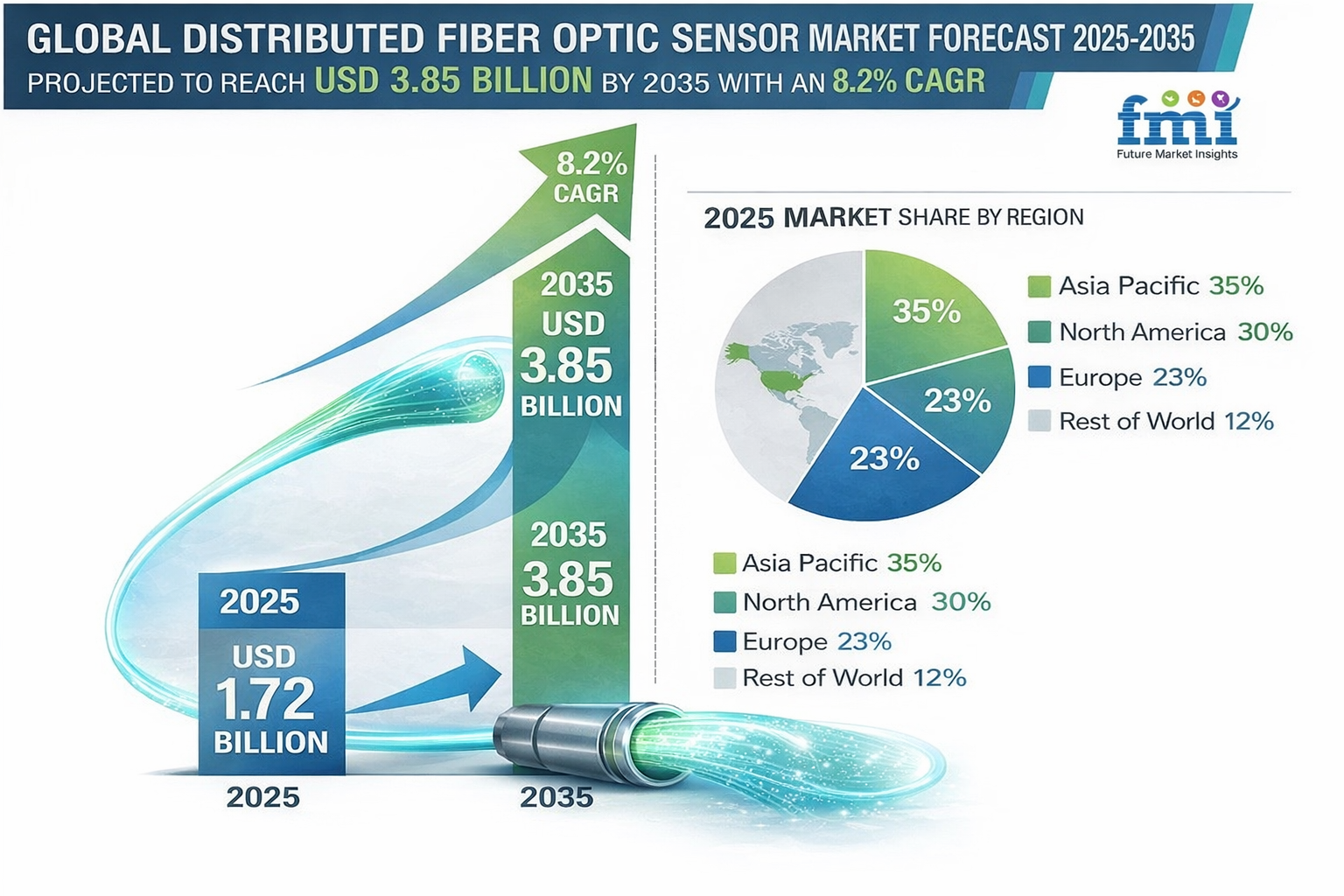
NEWARK, DELAWARE / ACCESS Newswire / February 5, 2026 / The global distributed fiber optic sensor (DFOS) market is entering a phase of sustained, technology-driven expansion, projected to grow from USD 1.72 billion in 2025 to approximately USD 3.85 billion by 2035, registering a compound annual growth rate (CAGR) of 8.2%. Market growth is underpinned by rising demand for real-time condition monitoring, infrastructure resilience, and predictive safety systems across energy, transportation, defense, and industrial sectors.
Distributed fiber optic sensors have evolved from niche monitoring tools into mission-critical infrastructure intelligence platforms, enabling continuous, long-distance measurement of temperature, strain, vibration, and acoustic signals. Over the forecast period, the market is expected to generate an absolute dollar opportunity of more than USD 2.1 billion, reflecting its growing strategic importance within smart infrastructure and Industry 4.0 ecosystems.
Infrastructure Safety, Energy Efficiency, and Automation Drive Market Momentum
Distributed fiber optic sensing solutions provide high-resolution, real-time visibility across tens to hundreds of kilometers, making them uniquely suited for large-scale assets such as pipelines, power cables, railways, tunnels, and border perimeters. As industries prioritize operational continuity and failure prevention, DFOS technologies are increasingly deployed to support predictive maintenance, early fault detection, and automated response systems.
The market is projected to reach USD 2.75 billion by 2030, generating nearly USD 1.0 billion in incremental value during the first half of the forecast period. Adoption is accelerating as infrastructure operators seek alternatives to discrete sensors that lack scalability, durability, and continuous coverage.
Key demand drivers include:
Rising investments in smart grids, pipelines, and transportation corridors
Increased focus on industrial safety and regulatory compliance
Growing need for remote monitoring in harsh and inaccessible environments
Technologies such as Distributed Temperature Sensing (DTS) and Distributed Acoustic Sensing (DAS) are central to this expansion, offering immunity to electromagnetic interference and superior reliability under extreme conditions.
AI-Enabled Analytics Elevate Distributed Sensing from Detection to Decision-Making
The integration of artificial intelligence and machine learning is reshaping the distributed fiber optic sensor landscape. Modern DFOS platforms no longer stop at anomaly detection; they deliver context-aware insights, event classification, and predictive diagnostics.
AI-enhanced systems can distinguish between environmental noise and critical threats-such as leaks, intrusions, or structural stress-allowing operators to respond with greater speed and precision. This intelligence layer is proving especially valuable in rail safety, pipeline monitoring, perimeter security, and seismic activity analysis.
As governments and enterprises deploy digital twins and smart infrastructure frameworks, AI-driven fiber optic sensing is becoming a foundational technology for automated asset management and long-term infrastructure planning.
Condition Monitoring Emerges as the Dominant Application Segment
Condition monitoring represents the largest application segment, accounting for an estimated 35.8% of global market share in 2025. Distributed fiber optic sensors enable continuous assessment of asset health by monitoring temperature gradients, strain variations, vibration patterns, and acoustic disturbances across extensive distances.
This capability is critical in industries where asset failure carries high economic, environmental, or safety risks. Oil & gas pipelines, power transmission networks, rail infrastructure, and civil structures increasingly rely on DFOS-based condition monitoring to reduce unplanned downtime and extend asset lifecycles.
Leading vendors are enhancing these systems with cloud connectivity, SCADA integration, and AI-powered dashboards, enabling operators to visualize infrastructure health in real time and schedule interventions proactively.
Distributed Temperature Sensing Anchors Sensor-Type Leadership
By sensor type, Distributed Temperature Sensors (DTS) lead the market, capturing approximately 35.5% share in 2025. DTS systems are widely deployed for thermal profiling, fire detection, leak identification, and cable monitoring, particularly in energy and industrial environments.
Their passive operation, high spatial resolution, and resistance to harsh conditions make them indispensable for:
Oil & gas wellbore integrity monitoring
Power cable and substation temperature control
Tunnel, data center, and industrial fire detection
Ongoing innovation-particularly the integration of AI-driven alerts and automated maintenance workflows-is reinforcing DTS leadership as safety and efficiency requirements tighten globally
Regulatory Compliance and National Security Applications Strengthen Adoption
Regulatory frameworks across energy, infrastructure, and defense sectors are accelerating DFOS adoption. Governments increasingly mandate real-time monitoring, safety certification, and data security compliance for critical assets.
Key regulatory considerations include:
Compliance with IEC and ISO equipment safety standards
Adherence to data privacy regulations such as GDPR
Alignment with national security and infrastructure protection policies
Distributed fiber optic sensors are now embedded in border surveillance systems, rail safety programs, and pipeline integrity regulations, positioning them as essential tools for regulatory compliance and risk mitigation.
Regional Growth Patterns Reflect Infrastructure Investment Intensity
Region | Market Position | Key Growth Drivers |
|---|---|---|
Asia Pacific | Leads by volume | Large-scale infrastructure development, smart city initiatives, rapid urbanization |
North America | Dominates by market value | High-tech deployments in energy systems, security infrastructure, and defense applications |
Europe | Regulation-driven growth | Stringent safety standards, environmental regulations, and energy efficiency mandates |
India | Fastest-growing market | Rapid infrastructure expansion, digitalization programs, investments in transport & power |
Competitive Landscape Shifts Toward Integrated Intelligence Platforms
The DFOS market is moderately consolidated, with Tier-1 players such as Schlumberger, Halliburton, and OptaSense (QinetiQ) leading large-scale deployments in oil & gas and national security applications. These companies offer end-to-end sensing platforms, combining robust hardware with analytics-driven software ecosystems.
Other key participants-including AP Sensing, Silixa, Luna Innovations, and Yokogawa Electric Corporation-are strengthening their positions through AI integration, modular system design, and application-specific solutions.
Competition is increasingly defined by:
Analytics sophistication and AI capability
System interoperability and deployment flexibility
Long-term reliability in harsh operating environments
Outlook: Distributed Fiber Optic Sensors Become Core to Smart Infrastructure Strategy
As global infrastructure systems grow more complex and interconnected, distributed fiber optic sensors are emerging as cornerstone technologies for real-time intelligence, safety assurance, and operational resilience. Their ability to deliver continuous monitoring over vast distances aligns directly with the needs of smart cities, energy transition projects, and critical asset protection initiatives.
With sustained investment in infrastructure modernization, automation, and security, the distributed fiber optic sensor market is well-positioned for durable growth through 2035 and beyond, driven by innovation, AI integration, and the global shift toward predictive, data-driven infrastructure management.
For an in-depth analysis of evolving formulation trends and to access the complete strategic outlook for the Distributed Fiber Optic Sensor Market through 2036, visit the official report page at: https://www.futuremarketinsights.com/reports/distributed-fiber-optic-sensors-market
About Future Market Insights (FMI)
Future Market Insights (FMI) is a leading provider of market intelligence and consulting services, serving clients in over 150 countries. Headquartered in Delaware, USA, with a global delivery center in India and offices in the UK and UAE, FMI delivers actionable insights to businesses across industries including automotive, technology, consumer products, manufacturing, energy, and chemicals.
An ESOMAR-certified research organization, FMI provides custom and syndicated market reports and consulting services, supporting both Fortune 1,000 companies and SMEs. Its team of 300+ experienced analysts ensures credible, data-driven insights to help clients navigate global markets and identify growth opportunities.
For Press & Corporate Inquiries
Rahul Singh
AVP - Marketing and Growth Strategy
Future Market Insights, Inc.
+91 8600020075
For Sales - [email protected]
For Media - [email protected]
For web - https://www.futuremarketinsights.com/
SOURCE: Future Market Insights, Inc.
Information contained on this page is provided by an independent third-party content provider. XPRMedia and this Site make no warranties or representations in connection therewith. If you are affiliated with this page and would like it removed please contact [email protected]
