
Global Golf Cart Market to Reach USD 3.68 Billion by 2035 as Electrification, Smart Mobility, and Leisure Infrastructure Expansion Drive Demand
Electrification, Smart Features, and Expanding Leisure Infrastructure Transform Low-Speed Mobility Solutions Worldwide
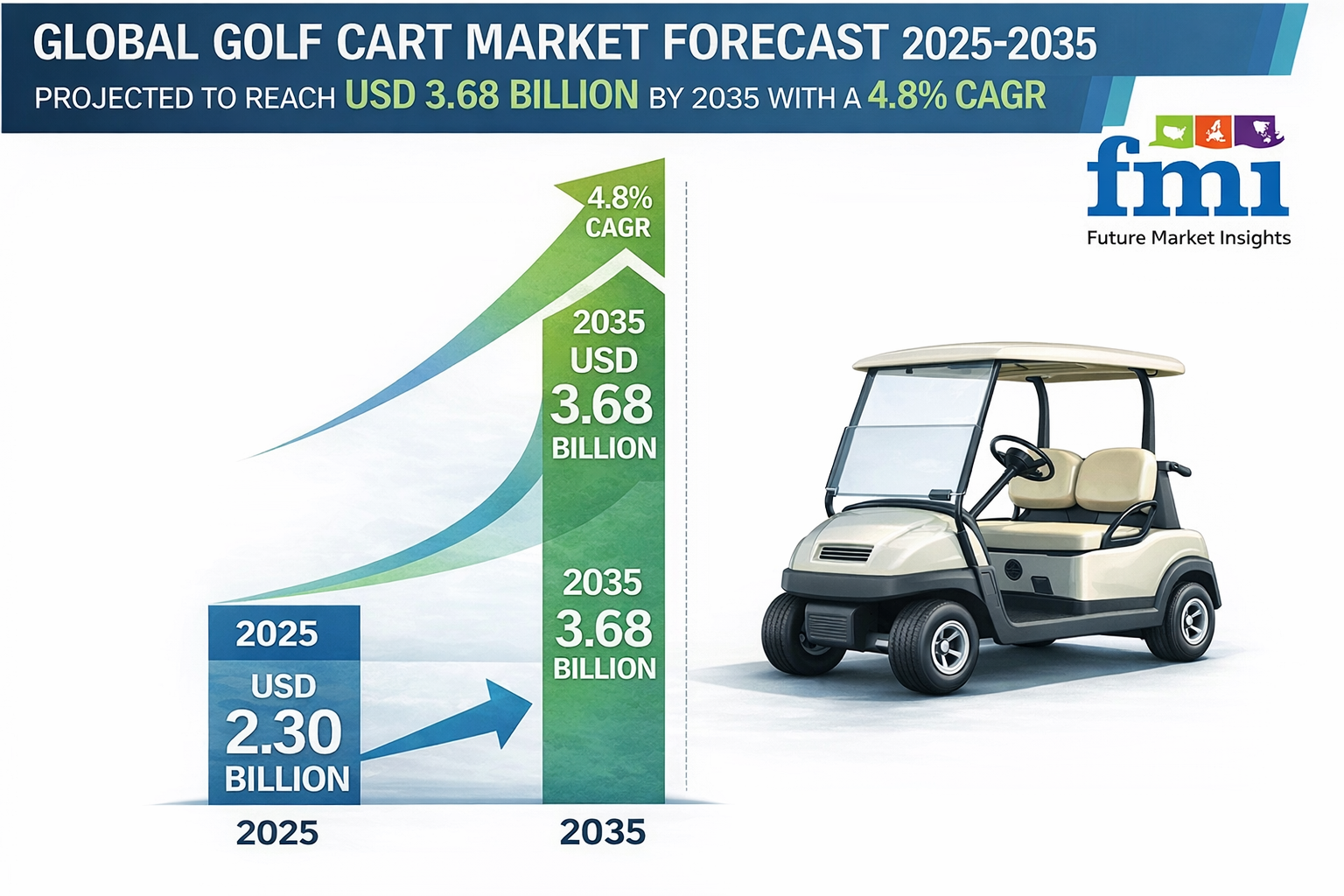
NEWARK, DELAWARE / ACCESS Newswire / February 5, 2026 / The global golf cart market is undergoing a steady but structurally significant transformation as electric mobility adoption, smart technology integration, and diversified end-use applications redefine demand dynamics. Valued at USD 2.30 billion in 2025, the market is projected to reach USD 3.68 billion by 2035, expanding at a compound annual growth rate (CAGR) of 4.8%, according to the latest strategic outlook by Future Market Insights (FMI).
Once confined primarily to golf courses, golf carts have evolved into multi-utility, low-emission mobility solutions across residential communities, airports, resorts, amusement parks, industrial campuses, and smart cities. This shift reflects a broader redefinition of short-distance transportation, where efficiency, sustainability, and operational flexibility are becoming critical decision drivers.
From Fairways to Facilities: Expanding Use-Case Economics
The modern golf cart is no longer a niche leisure vehicle. Increasing adoption across hospitality, tourism, residential mobility, and commercial logistics is driving consistent year-on-year growth. In 2024, the industry maintained stable momentum, with forecasted YoY growth of 4.1% for 2025, supported by expanding leisure infrastructure and rising demand for low-speed electric vehicles (LSEVs).
Electric golf carts, in particular, are gaining preference as governments worldwide tighten emission norms and promote clean mobility. Their silent operation, zero emissions, and lower lifetime operating costs position them as a compelling alternative to gasoline-powered carts, especially in regulated or noise-sensitive environments.
Electrification as the Core Growth Engine
According to FMI, electric golf carts are expected to account for approximately 95.3% of total market share by 2025, cementing their dominance as the industry standard. This shift is driven by:
Lower fuel and maintenance costs
Supportive EV policies and incentives
Improved battery reliability and charging efficiency
Increasing sustainability mandates across hospitality and real estate sectors
Advancements in lithium-ion battery technology are further enhancing product value. Newer models offer extended driving range, faster charging cycles, and longer battery life-addressing historical limitations of electric carts.
Smart Technology Integration Reshapes Product Differentiation
Manufacturers are increasingly embedding smart and connected features to elevate both user experience and fleet efficiency. In 2024, leading players such as Club Car and Yamaha introduced next-generation electric golf carts equipped with:
Advanced battery management systems
GPS-enabled fleet tracking
Mobile app integration
Touchscreen displays and real-time diagnostics
These innovations are transforming golf carts into data-enabled mobility platforms, particularly valuable for large resorts, golf clubs, and industrial facilities managing extensive fleets.
Comfort, Safety, and Customization Drive Premiumization
Beyond propulsion technology, product differentiation is accelerating through enhanced ergonomics, safety, and personalization. Modern golf carts now feature improved suspension systems, ergonomic seating, advanced lighting, and customizable aesthetics.
Personalization has emerged as a key purchase driver, with buyers seeking carts tailored for specific applications-ranging from luxury resort transport to utility-focused industrial use. The rise of golf cart rental services, especially in Asia Pacific, is further broadening consumer access and boosting utilization rates without ownership barriers.
Two-Seater Golf Carts Retain Volume Leadership
By seating capacity, two-seater golf carts are projected to hold the largest share, accounting for approximately 39.3% of the market by 2025. Their affordability, compact design, and ease of operation make them ideal for individual golfers, small resorts, and gated communities.
This segment is expected to grow steadily at a CAGR of 5.2% through 2025, supported by strong demand for cost-efficient and maneuverable mobility solutions.
Regional Outlook: Asia Pacific Emerges as Growth Epicenter
While North America remains the largest market, driven by a dense concentration of golf courses and high disposable income, Asia Pacific is expected to witness the fastest growth during the forecast period.
India (8.3% CAGR) leads global growth, supported by rapid urbanization, expanding leisure infrastructure, and government initiatives such as Make in India and the National Electric Mobility Mission Plan.
China (6.2% CAGR) benefits from leadership in electric battery technology and rising adoption of rental golf carts in tourism zones.
Japan (5.3% CAGR) sees strong demand from aging populations and sustainability-focused residential mobility.
United States (4.7% CAGR) continues to favor premium, customizable, and technologically advanced carts.
Market Metrics at a Glance (2025-2035)
Metric | Value |
|---|---|
Market Value (2025) | USD 2.30 Billion |
Market Value (2035) | USD 3.68 Billion |
Global CAGR | 4.8% |
Dominant Propulsion | Electric (95.3% Share) |
Fastest-Growing Country | India (8.3% CAGR) |
Competitive Landscape: Scale, Technology, and Customization
The global golf cart market remains moderately concentrated, with Tier-1 players controlling 40-45% of total revenue. Leading manufacturers include Club Car, E-Z-GO (Textron), Yamaha Motor Corporation, Lvtong, and Kandi America, leveraging strong manufacturing capabilities and global distribution networks.
Tier-2 and Tier-3 players are gaining traction by serving niche applications, regional demand, and luxury customization segments. Across all tiers, manufacturers are prioritizing electric powertrains, lithium-ion batteries, smart connectivity, and modular design to remain competitive.
Outlook Through 2035
Looking ahead, sustained investments in smart mobility, eco-friendly transportation, and leisure infrastructure are expected to support long-term market expansion. While high maintenance costs and substandard low-quality products pose challenges, continued innovation and regulatory support for electric vehicles will underpin steady growth.
As golf carts transition from recreational vehicles to integral components of modern short-distance mobility ecosystems, the market is well-positioned to deliver consistent value across diverse user segments through 2035.
For an in-depth analysis of evolving formulation trends and to access the complete strategic outlook for the Golf Cart Marketthrough 2035, visit the official report page at: https://www.futuremarketinsights.com/reports/golf-cart-market
Related Reports:
Golf Cart Batteries Market - https://www.futuremarketinsights.com/reports/golf-cart-batteries-market
Golf Cart Battery Market - https://www.futuremarketinsights.com/reports/golf-cart-battery-market
Electric Golf Cart Market - https://www.futuremarketinsights.com/reports/electric-golf-cart-market
GCC Electric Golf Cart Market - https://www.futuremarketinsights.com/reports/gcc-electric-golf-cart-market
Japan Electric Golf Cart Market - https://www.futuremarketinsights.com/reports/japan-electric-golf-cart-market
About Future Market Insights (FMI)
Future Market Insights (FMI) is a leading provider of market intelligence and consulting services, serving clients in over 150 countries. Headquartered in Delaware, USA, with a global delivery center in India and offices in the UK and UAE, FMI delivers actionable insights to businesses across industries including automotive, technology, consumer products, manufacturing, energy, and chemicals.
An ESOMAR-certified research organization, FMI provides custom and syndicated market reports and consulting services, supporting both Fortune 1,000 companies and SMEs. Its team of 300+ experienced analysts ensures credible, data-driven insights to help clients navigate global markets and identify growth opportunities.
For Press & Corporate Inquiries
Rahul Singh
AVP - Marketing and Growth Strategy
Future Market Insights, Inc.
+91 8600020075
For Sales - [email protected]
For Media - [email protected]
For web - https://www.futuremarketinsights.com/
SOURCE: Future Market Insights, Inc.
Information contained on this page is provided by an independent third-party content provider. XPRMedia and this Site make no warranties or representations in connection therewith. If you are affiliated with this page and would like it removed please contact [email protected]
